
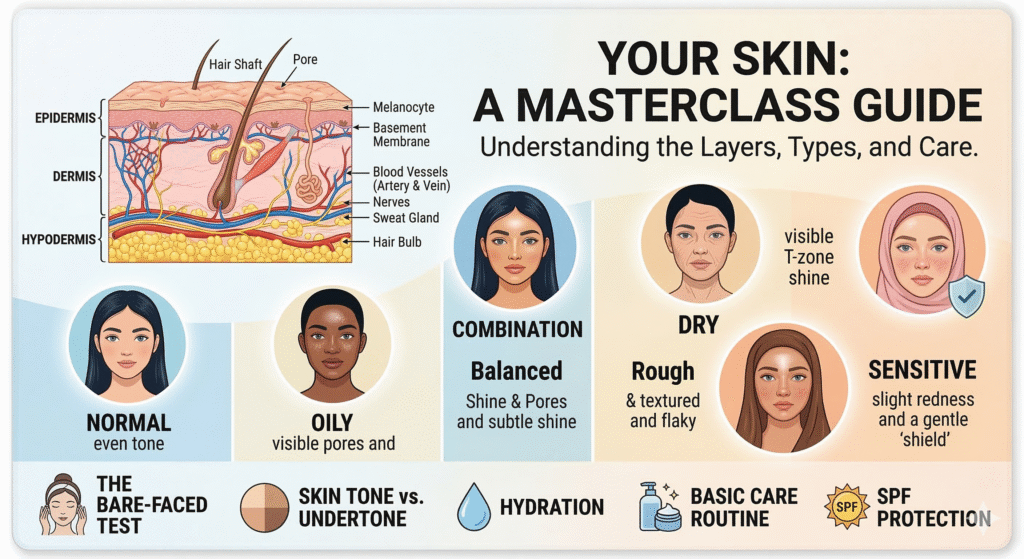
Hello, students! Today we are diving deep into the body’s largest organ: the skin. Often overlooked as just an outer “wrapper,” your skin is a complex, living system that protects you, breathes with you, and reflects your internal health.
Whether you’re aspiring to be a dermatologist, an aesthetician, or just want to take better care of yourself, this guide will cover everything you need to know.
What Exactly is Skin?
The skin is the primary organ of the integumentary system. It’s not just a surface; it’s a multi-functional barrier. Its primary jobs include:
- Protection: Guarding against pathogens, UV radiation, and physical injury.
- Regulation: Maintaining body temperature through sweat and blood flow.
- Sensation: Detecting touch, heat, cold, and pain via a vast network of nerves.
- Synthesis: Producing Vitamin D when exposed to sunlight.
The Architecture: Layers of the Skin
To understand how products and injuries affect us, we have to look under the “hood.” The skin consists of three primary layers:
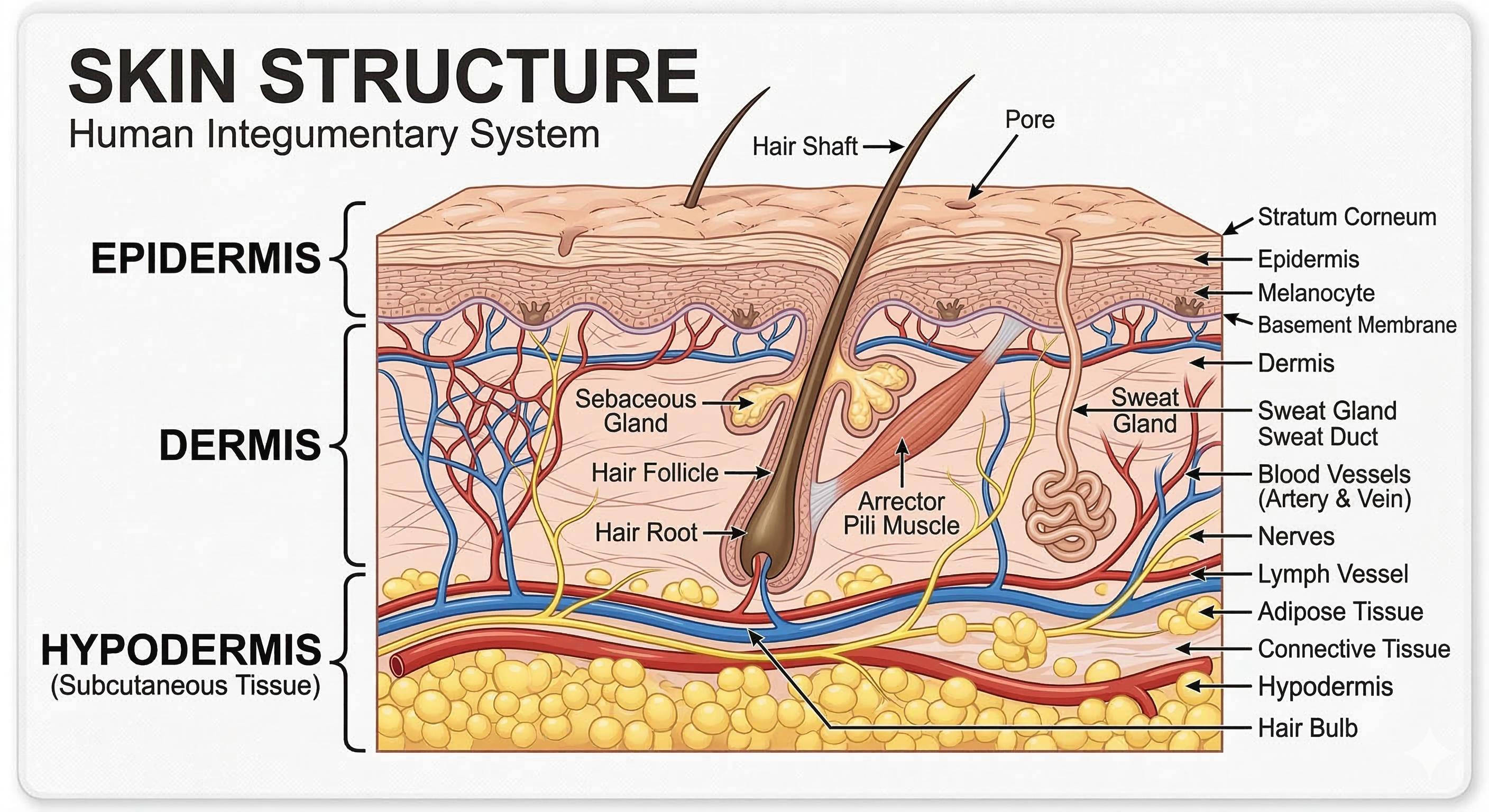
The Epidermis (The Shield)
The outermost layer. It is waterproof and creates our skin tone. It contains melanocytes, which produce melanin (pigment).
The Dermis (The Engine Room)
Located beneath the epidermis, this layer contains tough connective tissue, hair follicles, and sweat glands. It’s where collagen and elastin live, giving your skin its strength and “snap-back” ability.
The Hypodermis (The Cushion)
The deeper subcutaneous tissue made of fat and connective tissue. It acts as an insulator and a shock absorber for your internal organs.
Identifying Skin Types
Knowing your skin type is the “Golden Rule” of skincare. Most people fall into one of these five categories:
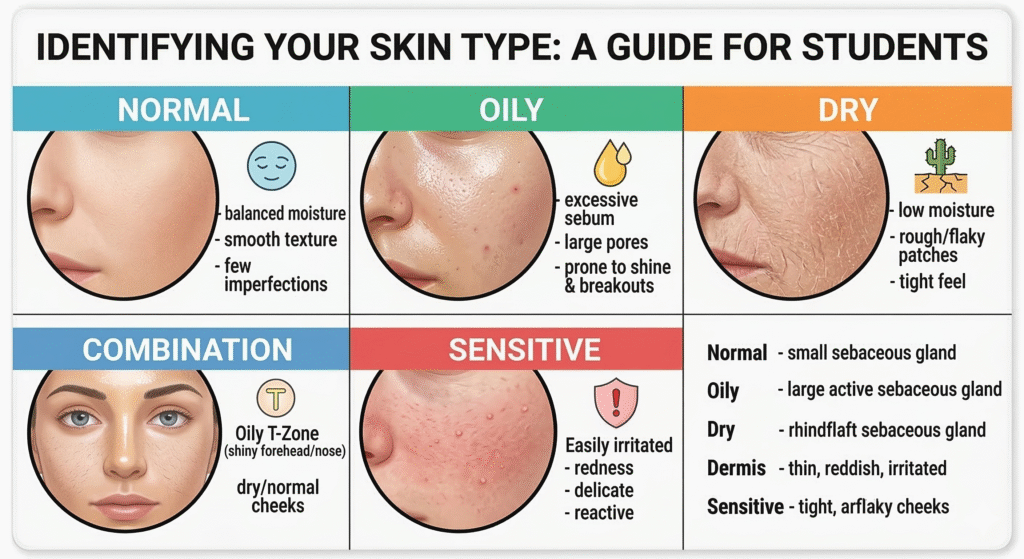
- Normal: Balanced moisture; not too oily and not too dry. Few imperfections.
- Oily: Overproduction of sebum. Characterized by enlarged pores, a shiny complexion, and a tendency toward breakouts.
- Dry: Lacks oil. May feel tight, look dull, or show flaky patches.
- Combination: Usually oily in the “T-Zone” (forehead, nose, and chin) and dry or normal on the cheeks.
- Sensitive: Easily irritated. Often reacts to new products with redness, itching, or burning.
How to Determine Your Skin Type and Tone
You don’t need a lab to figure this out! Try these methods:
- The “Bare-Faced” Test (For Type)
Wash your face with a mild cleanser. - Gently pat dry and do not apply any products.
- Wait 30–60 minutes.
- If it feels tight = Dry.
- If it’s shiny on the nose and forehead only = Combination.
- If it’s shiny all over = Oily.
- If it feels comfortable and hydrated = Normal.
Determining Skin Tone vs. Undertone
- Skin Tone: This is your surface color (Fair, Medium, Olive, Deep). It can change with sun exposure.
- Undertone: This is the hue underneath the surface, and it never changes.
- Cool: Pink, red, or bluish hints. (Veins look blue/purple).
- Warm: Yellow, peachy, or golden hints. (Veins look green).
- Neutral: A mix of both. (Veins look blue-green).
Factors That Affect Skin Health
Your skin is a storyteller. It reacts to:
- Hydration: Water intake keeps cells “plump.”
- Diet: High-sugar diets can trigger inflammation and acne.
- Sleep: This is when the skin goes into “repair mode,” regenerating cells.
- UV Exposure: The #1 cause of premature aging and skin cancer.
The Basic Skincare Routine
For students just starting out, keep it simple. You don’t need a 10-step routine. You just need the “Big Three”:
- Cleanse: Remove dirt and excess oil.
- Moisturize: Lock in hydration and protect the skin barrier.
- Protect (SPF): Never skip sunscreen! It is the most important anti-aging tool in your kit.